Autonomy assessment: evidence for a review, not a score
An agent's autonomy is how much it is allowed to do without a person deciding first. Customers widen it as an agent earns trust and narrow it when it does not. The Autonomy tab on an agent gives the person who decides the evidence for that decision, in one place, for a window you choose.
It does not give a score, a grade or a readiness rating. It shows what was granted, what was attempted, what a destination system confirmed and what is not known, each with its counts. And it changes nothing: Provantix does not grant, revoke or block access. Whatever the owner decides is made in your own control systems.
In the product
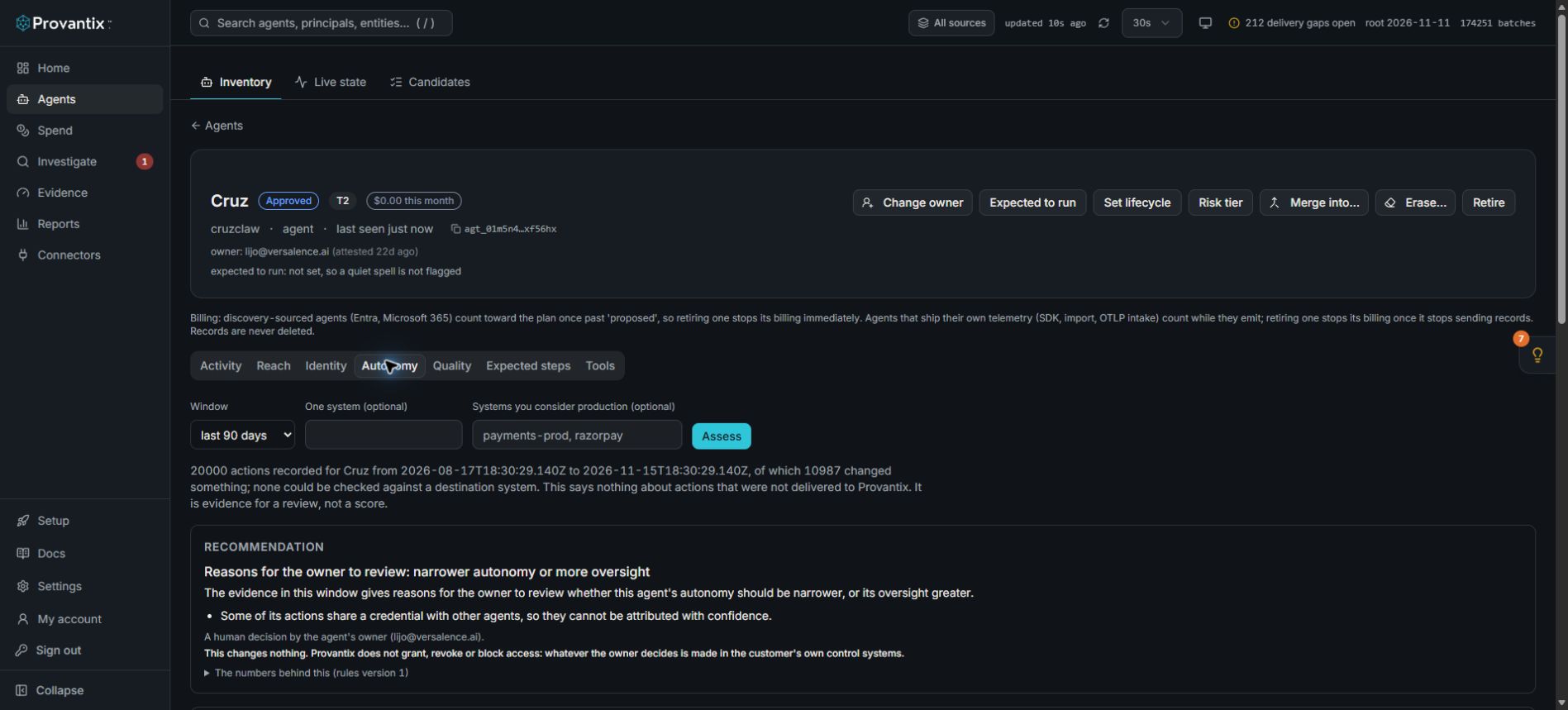
Product capture, 15–16 November 2026. Open the image for full size. Counts and dates are examples from the captured workspace.
Open an agent and select Autonomy. Read the window, recommendation and missing evidence together. The assessment supports an owner review; it does not grant or revoke access. This example has no destination confirmation for the changing actions.
Four things, kept apart
| What it shows | Where it comes from | |
|---|---|---|
| Authority granted | The owner, lifecycle, risk tier, reach and approval-required systems the agent had at the start of the window, and what changed in it. | The agent's append-only authority history, never today's values in place of the past. |
| Actions attempted | How many actions the agent recorded, how many changed something, by kind and by system. | The records delivered to Provantix. |
| Outcomes confirmed | Of the changing actions a destination system can be checked against, how many the destination's own record confirmed, with the count out of how many, and a 95% interval. | Destination confirmation. |
| What is not known | Written from the data every time: too few actions, actions no destination covers, checks still pending, shared credentials, approvals recorded but not verified. | All of the above. |
Beside them, the assessment shows approvals (recorded and verified are separate answers), later reversals, disputes and overrides, how sure the records are the agent's own, and how many changing actions have a stated reason (decision evidence).
How to read the numbers
- Every share has its denominator. "50 of 57 resolved checks", never a bare percentage. Pending checks and actions with no destination check are left out of the denominator and counted on their own line.
- Small samples say so. The interval is wide when there are few checks, and below 30 resolved checks the share is marked too few to read.
- A recorded approval is not verified authority. Present means an approval was recorded. Verified means it covers this exact action, judged by the policy version in force when the action ran.
- A signed record is not a true one. It shows the agent said it did something. A destination-confirmed change shows the change was made, not that it was a good one.
- Production is never guessed. Provantix does not record which systems are production. Name the ones you consider production and the changes that touched them are counted separately, marked as your declaration.
- Autonomy mode is not recorded yet. Whether an agent is observe-only, recommends, needs approval or is independently authorized is not supplied by any source today, so it reads as unknown: not as unauthorized, not as authorized.
The recommendation
There are four possible statements, each with its reasons, and the thresholds that produced it are shown:
- Not enough evidence to say anything. Fewer than 20 changing actions, or too few resolved destination checks.
- Reasons for the owner to review narrower autonomy or more oversight. For example an approval that does not cover its action, a change on an approval-required system with no approval, a conflicting or unverified share of 10% or more of resolved checks, a reversal share of 10% or more, or a shared credential.
- The evidence would support a review of broader autonomy. Only when at least 50 checks are resolved, the 95% interval's lower end is at least 95%, attribution is by explicit id or mapped identity for at least 90% of actions, and none of the concerns above applies. It does not say broader autonomy is warranted.
- No reason to review, and not strong enough to suggest broader autonomy.
Every one of them is addressed to the agent's human owner. If the agent has no recorded owner, the assessment says there is no one to decide and to name an owner first.
Recording a review
An owner can record a review with a decision (no change, adjusting it in our own control systems, needs more evidence, revisit later) and a note. Provantix stores the assessment as it was measured at that moment, with the decision, the note, who recorded it and who the owner was. Later changes to policy, owner or reach never rewrite it. Reviews are listed on the tab. Recording one changes no access.
An assessment of a past window does not change
The same window reads the same after you change the owner, widen the agent's reach, add an approval-required system or set a new approval policy version. The one thing that can legitimately change is a destination check: a destination record that arrives late can turn pending into confirmed, because that is new evidence and not an edit.
Limits
- Only the first 20,000 records in a window are assessed; the page says when that cut applies.
- The thresholds are fixed numbers, shown with every assessment. They are not tuned per customer and are not a standard.
- It reports what was recorded. It is not an opinion on whether an agent should be trusted, and it is not an audit.