Cost incidents: security and cost in one account
The incident view is built for security: a timeline of sealed records, what each was allowed to do, corrections. A cost event had no incident, and the two are often the same event. A compromised key is found by its bill. A runaway agent is both a spend problem and a question of what it touched. A cost incident holds both, so security and finance read one account.
Cost incidents are listed on the Incidents page, above the derived incidents, and open at their own page.
In the product
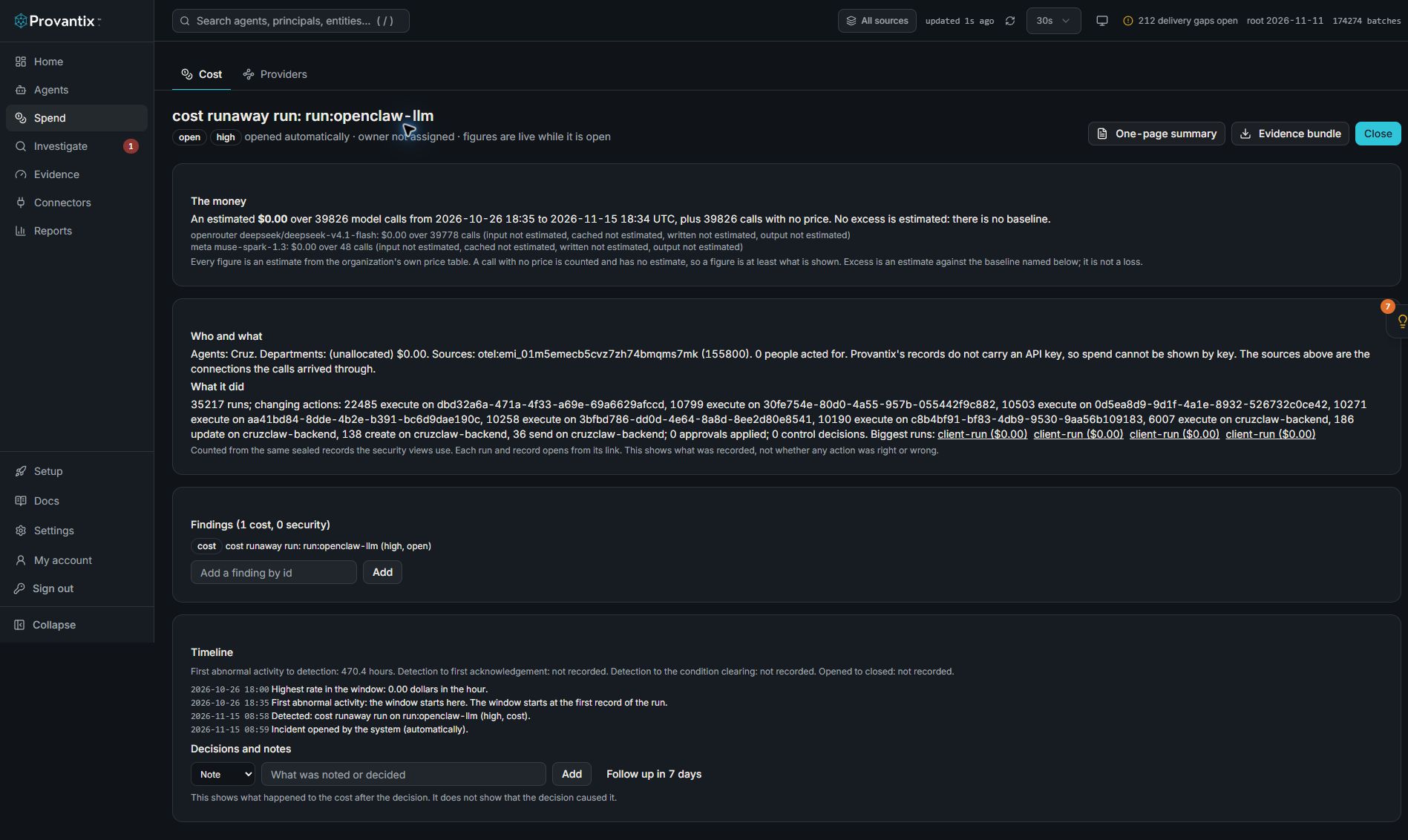
Product capture, 15–16 November 2026. Open the image for full size. Counts and dates are examples from the captured workspace.
Read The money together with unpriced-call and baseline notes. This open incident has live figures, unpriced calls and no baseline, so no excess is estimated. Its timeline distinguishes first activity, detection and opening; not recorded is not an elapsed time of zero.
Opening one
- From a cost trigger, by hand: a spend rate, a runaway run, a budget crossed or forecast, a new spender, a failure burn, a security-and-cost finding, or untracked usage. Open it from the finding. One finding has one open incident.
- Automatically, above a severity the organization chooses (high by default; medium and above, any, or never). It opens when a cost finding appears at or above that severity and has no incident for that episode. A person closes it.
- From a security incident, by giving its key: cost evidence is added to it. Or the other way: add security findings to a cost incident. One incident, two kinds of evidence, each finding labelled cost or security.
The window starts at the first minute the fast check counted as abnormal (a runaway run: its first record; a budget: an hour before the finding; untracked usage: a day before, since providers report by day). The page says which. A person can set the start.
What it holds
The money. Spend in the window, by model and token kind (uncached input, cached read, cache write, output), from the organization's own price table. The excess is an estimate against a stated baseline: the average of the same window on up to the previous four weeks for the same agents. It is never called a loss. Agents with under a week of history have no baseline and the page says so. The provider's own figure appears per day, whole, for the days the window touches, once the day has settled and been compared (see reconciliation); a provider reports by day, so it cannot be cut to the window.
Untracked usage says plainly that Provantix has no records for it and so cannot say who or what made it. It does not guess an agent, person, department or key.
Who and what. The agents, departments and products by spend, the sources the calls arrived through, and how many people the agents acted for. People are counted, not named: named person-level spend is for an admin where the organization turned it on. API keys are not on Provantix's records, so spend cannot be shown by key.
What it did. From the same sealed records the security views use: the runs (each opens), the systems touched by changing actions with example records, approvals applied and control decisions.
The timeline. The first abnormal activity, detection, each alert sent, each acknowledgement and escalation, a tool's own reports, the rate peak, the condition clearing, and every note and decision with who and when. With the response-loop times: first abnormal activity to detection, detection to first acknowledgement, detection to the condition clearing, opened to closed. A stage with nothing recorded is "not recorded", not zero.
What was decided. Notes and decisions, each with who and when, an owner, and a follow-up: some days after close Provantix reads the same agents' spend against what was usual for a window that long and says it stayed down, came back, or that there was not enough to say. It says what happened, not what caused it.
Figures freeze at close
When the incident is closed its figures are frozen with the prices and the provider figures as they were. If the provider later restates a figure, the restatement is appended as a correction (the same idea as corrections to a derived incident) and the original stays. A closed incident reads from the frozen figures, so re-pricing a model or later spend never changes it.
The one-page summary
Every incident has a one-page summary a finance or security officer can read without the product: what happened, how much (as an estimate), who owned it, how long each stage took, what was decided, and any restatement. It carries the estimate and causation statements.
The evidence bundle
The bundle is the standard export of the incident's records, which the verification kit checks like any export, plus a cost section: cost/cost-section.json (the figures, how each was calculated, the prices used, the provider figures with the time they were fetched, which parts are estimates, the timeline and corrections), cost/README-cost.txt and cost/summary.html. If a security incident is carried with it, its records are in the bundle too. The window's records are included up to 2,000; the section says if it was cut.
What the verifier checks for cost: that each cost file is exactly the file Provantix issued. Its hash is in manifest.json, which is signed, so changing a figure after issue is caught.
What it does not check: that the figures are right. The verifier does not recompute cost, does not hold the price table beyond the rows listed, and cannot reach the provider. Spend is an estimate; excess is an estimate against a stated baseline; the provider's figures are as the provider reported them at the fetch time. A reviewer can recompute the spend from the tokens in records.jsonl and the prices in the section.
Access
Reading follows the same rules as the other incident views. Opening by hand, adding findings, notes, owners, closing, follow-ups and the severity setting are admin actions and are audited. Person-level detail follows the organization's choice about people and departments.
API
GET /api/cost-incidents (and ?status=), POST /api/cost-incidents (finding_id, or security_key, or agents, with window_start, title, severity, owner), GET /api/cost-incidents/<id>, .../summary (HTML), .../export (the bundle), POST .../findings|notes|owner|close|follow-up, PUT /api/cost-incidents/settings (auto_open_min_severity).
Limits
- Excess is only as good as the baseline. A window with no comparable weeks has none.
- A provider's day appears only once it has settled; an incident that closes before then has no provider figure and says so.
- Records and figures are estimates from the price table. A call with no price is counted and has no estimate.
- The bundle includes at most 2,000 records of the window.