Cost per outcome: what each run, action and confirmed result cost
Total spend tells finance what AI cost. It does not tell anyone whether it was worth it. Provantix already knows which runs ended, which actions changed something in another system, and which of those the destination system confirmed. Dividing cost by those gives a unit cost that a billing tool cannot produce. It is on the Cost page under "Cost per outcome".
Provantix reports cost per counted thing. It does not put a money value on an outcome and does not say whether the spend was worth it. That judgement is yours.
You can look at the whole organization, one agent (agent:<id>), or a tag such as a department, product or workflow (tag:department=Support). The period is shown against the previous period of the same length.
In the product
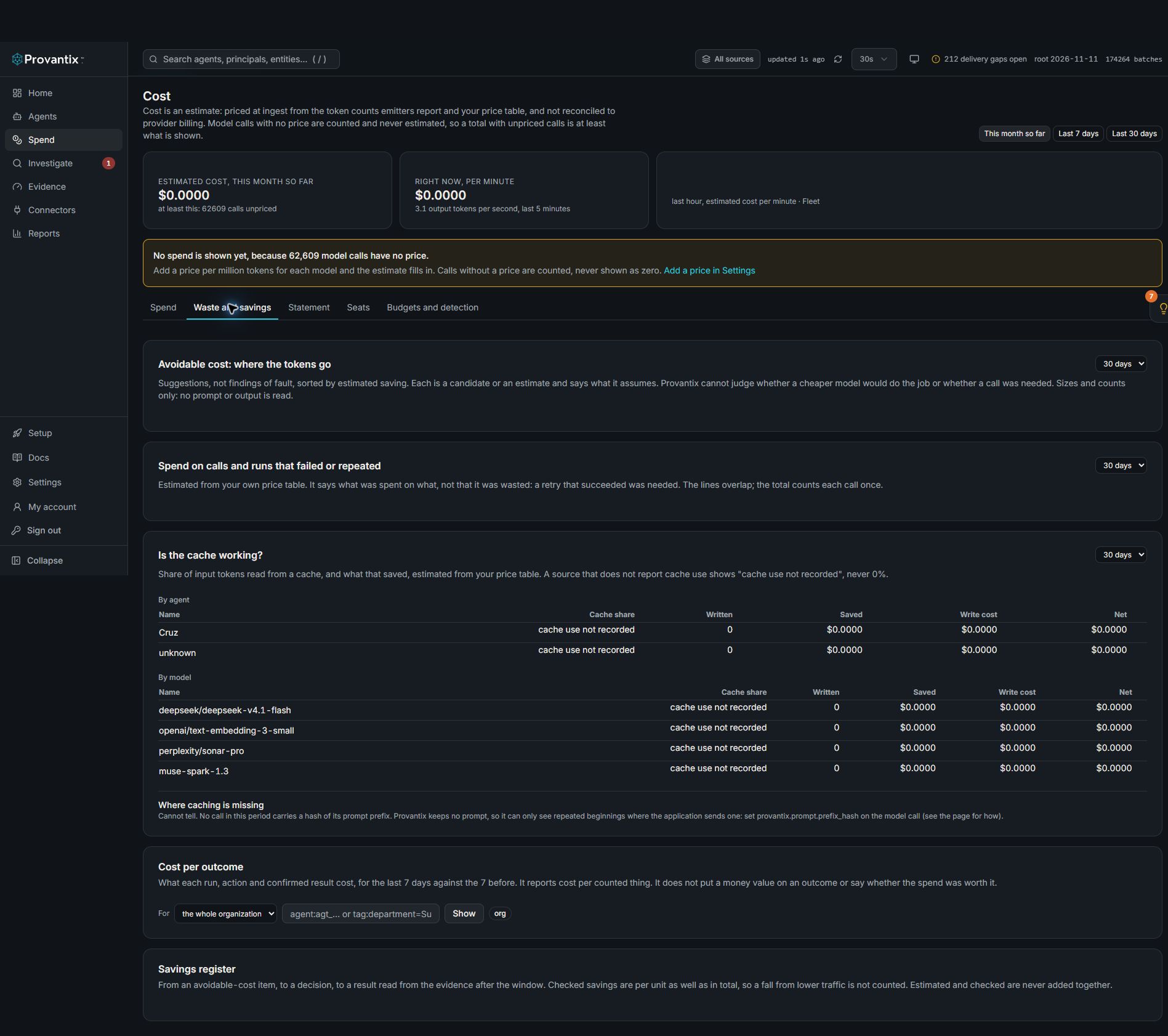
Product capture, 15–16 November 2026. Open the image for full size. Counts and dates are examples from the captured workspace.
Find Cost per outcome in Waste and savings. The scope control chooses the organisation or a narrower subject. The figure is cost per counted run, action or confirmed result; it is not a monetary valuation of the outcome.
The measures
| Measure | How it is added up |
|---|---|
| Cost per run | The cost of the runs that have ended, divided by how many ended. A run is a trace (or session); it has ended when nothing was recorded for 30 minutes. Runs still going are not counted. |
| Cost per successful run | The same cost, divided by the runs that ended without failure. Failures stay in the cost, so this is what a success cost, failures included. A run ended in failure when its last recorded outcome was a failure. Runs with no outcome recorded are counted apart and are not failures. |
| Cost per action | The cost, divided by the actions that changed something in another system (a write, create, update, delete, send, execute, grant, revoke or upload) and did not fail. |
| Cost per confirmed action | The cost of the runs holding actions a destination check covers, divided by the actions the destination confirmed. "Confirmed" has exactly the meaning it has everywhere else: the destination system's own record matched (see reconciliation for providers and the destination checks for actions). Where no destination source covers the actions, the line says "not checked against a destination": it is never zero and never 100%. Where some are covered, it says how many (for example "8 of 10 actions are covered"), and pending results are not counted as confirmed. |
| Cost per person served | The cost of the runs that name a person the agent acted for, divided by the distinct people. Only counts: nobody is named. Below the organization's small-group minimum (5 by default) it is not shown, because a figure for so few could point at one of them. |
| Cost per unit you define | See below. |
| Spend with no outcome | The cost of runs that produced no action and no unit you defined, and its share of the cost. A run with no counted outcome may have done something Provantix does not count (an answer someone read), so this is not a statement that the spend was wasted. |
All costs are the estimate from your own price table. A call with no price is counted and has no estimate, so a cost is at least what is shown.
Too few to say
A unit cost is shown only when there are enough outcomes behind it: at least 10 by default, a number the organization can change (admin). Below that the line says "too few to say" with the count, for example "too few to say: 6 outcomes, and at least 10 are needed". A figure from three outcomes would look as precise as one from three thousand, and it is not.
Outcomes you define
For an agent, an owner can say that a call to a tool, or an event of a type (optionally on a system), marks one unit of something: "a refund processed", "a ticket resolved". Provantix then reports the agent's cost per that unit. A call that failed is not counted.
This is the owner's statement. It is kept with who declared it and when. It is ended, never edited or deleted, so the history of what was counted is there, like expected steps. Outcomes you define are per agent; for a department or the whole organization the other measures are shown.
Why a unit cost moved
Each measure sits beside the previous period, with the split by model and token kind (uncached input, cached read, cache write, output).
For the cost of a successful run Provantix also takes the change apart into the only three things that can move it, since the cost of a successful run is tokens per run × cost per token ÷ share of runs that ended without failure:
- More tokens per run. The same work took more tokens.
- A dearer price per token. A different model, or a different mix of token kinds.
- Fewer runs ending without failure. Each success carries the cost of the failures.
It states each factor's change and its share of the whole change, and names the main driver. Where the models in use or the configuration the agents reported (feature flags, see configuration) changed in the same period, it says so, as a coincidence in the records and not a cause.
In the cost statement
The unit costs are available as an optional section of a period's cost statement: GET /api/unit-costs/statement?from=&to=&subjects=org,agent:<id>. The statement itself is not built yet.
API
GET /api/unit-costs?subject=&from=&to=(the default period is the last 7 days).GETandPUT /api/unit-costs/settings(min_outcomes, admin, audited).GETandPOST /api/agents/<id>/outcomes(name,marker_kindtoolorevent,marker_value,target_system),POST /api/outcomes/<id>/end(admin).
Limits
- Provantix counts what is recorded. An outcome the agent produced that leaves no record of a changing action or a unit you defined is not counted.
- "Confirmed" is only as wide as the destination checks you have set up.
- A run's failure is its last recorded outcome; a run that failed in the middle and recovered counts as without failure.
- Cost per person counts only runs where a source named the person.
- It reads every call of the period (at most 92 days) and says when a period is partial.