Avoidable cost: where the tokens go
After failures, repeats and caching, the remaining avoidable cost is in how calls are shaped: a context that grows with every step, an expensive model on a small job, work that could wait for a cheaper batch price. This page lists those as suggestions, on the Cost page under "Avoidable cost: where the tokens go" and on an agent's Tools tab.
They are not findings of fault, and none becomes a finding. Provantix cannot judge whether a cheaper model would do the job, or whether any call was needed.
In the product
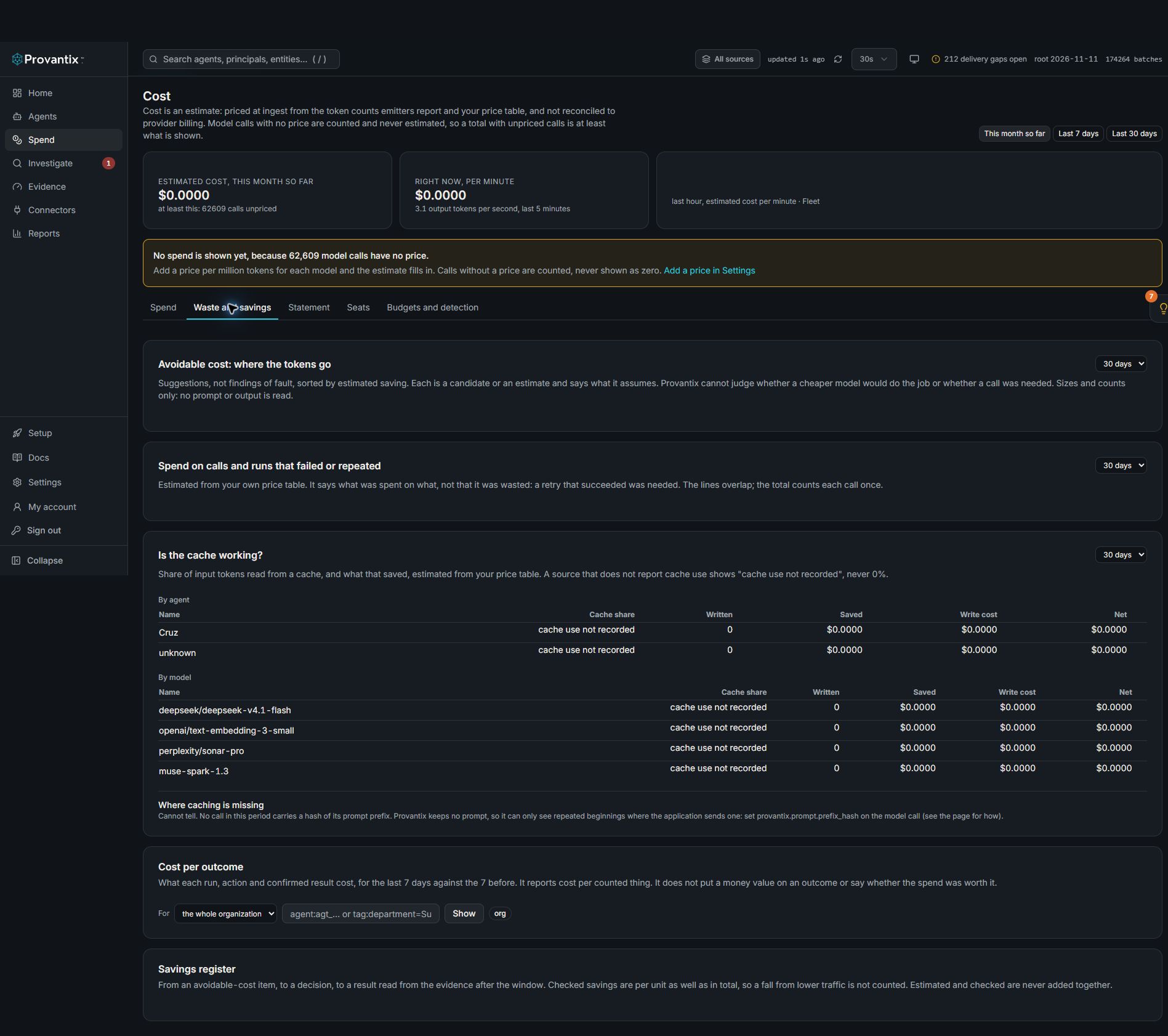
Product capture, 15–16 November 2026. Open the image for full size. Counts and dates are examples from the captured workspace.
Open Cost, then Waste and savings, and find Avoidable cost: where the tokens go. The same analysis is available on an agent’s Tools tab. Read each suggestion’s candidate or estimate label and its assumption before interpreting a possible saving; this capture does not demonstrate a realised saving.
How to read an item
- Candidate or estimate. A candidate is something you could act on. An estimate is a figure to read.
- One assumption, in a sentence. Every item states it.
- Estimated saving. From your own price table, at the normal input and output prices, using the price in effect at the end of the period. Caching would lower a real saving. A model with no price is counted and named, never valued at zero.
- Sorted by estimated saving. Items with no saving come last.
- Sizes and counts only. No prompt or output is read.
- Too little data. Where the data cannot support an insight, the page says so and why, rather than showing nothing.
The eight insights
| Insight | Formula | Assumption |
|---|---|---|
| Context grows through a run (estimate) | For runs with at least 4 model calls where the last call's input is at least 3 times the first: the sum over calls of the input above the first call's, at the normal input price. | The history could be trimmed or summarised so each call carried about what the first did. |
| Cost by step position (estimate) | For runs with at least 6 priced model calls: the share of the run's cost in its first, middle and last third of steps, added up over the agent's runs (at least 5 such runs). Says so when the last third holds half or more. | A reading, not a saving. |
| Calls with unusually large output (candidate) | Calls whose output is at least 4 times the agent's median for that model (from at least 30 calls) and at least 2,000 tokens: the output above the median, at the output price. | The output above the usual size was not needed. A long answer may be what was asked for. |
| Reasoning tokens (estimate) | For calls whose source records reasoning tokens (at least 10 per agent and model): the reasoning tokens at the reasoning price, or the output price where none is set, as a share of those calls' cost. | A reading, not a saving. Reasoning may be what makes the answer right. |
| Small calls on a high-priced model (candidate) | Calls with input of 2,000 tokens or fewer, output of 500 or fewer and no tool call in the run, on a model that has a cheaper priced model of the same provider in use in your organization (at most a third of its input price): the cost less the cost of the same tokens at the cheaper model. | The cheaper model would do the job. Provantix cannot judge that. Where the evaluator has reported results for both models on this agent, they are shown beside it as reported. |
| Calls that could wait for a batch price (candidate) | Calls of an agent with a declared schedule, with no requester recorded and on the normal tier: their cost times one minus the model's batch multiplier, where one is set. | Nobody was waiting for the answer and a delay up to the batch window would do. Only a declared schedule counts as a schedule. |
| Scheduled spend with no action elsewhere (candidate) | Agents with a declared schedule, with at least 5 runs and at least $1 spent, whose runs include no record other than model calls and reads: the cost of those runs. | An action in another system is the point of the run. The agent may produce something Provantix does not see, such as a report that is only read. |
| Most expensive runs (estimate) | The 10 runs with the highest estimated cost in the period, with their model and tool calls, tools used, duration and failed calls. | A list to read: an expensive run may have done valuable work. |
A run is a trace, or a session when there is no trace. A "requester" is a person the call acted for (see people and departments). Declare how often an agent runs on the agent's page.
Dismiss with a reason
An owner can dismiss a candidate for one agent, with a reason such as "needs the large model: legal review". It stays dismissed for that agent and that insight (and that model, where the insight is about one), and the dismissal is recorded with who, when and why. "Show dismissed" lists them. Restoring ends the dismissal; the history stays. Only an admin can dismiss or restore.
Thresholds
Every number above is a threshold your organization can change (under "Thresholds" on the section, or PUT /api/insights/settings, admin only). Each change is audited and versioned; the thresholds in force are shown with the results. Values are checked against a sensible range, and a value outside it is refused.
API
GET /api/insights?from=&to=&agent=&dismissed=1returns the items, the state of each insight, the dismissed count and the thresholds. A period is at most 92 days.POST /api/insights/dismissalswithagent_id,insight,subject(optional) andreason;POST /api/insights/dismissals/<id>/end(admin).GETandPUT /api/insights/settings.
Limits
- The estimates follow your price table. A wrong table gives wrong figures.
- "No tool call in the run" means no tool call was recorded in the same trace. A tool that is not traced makes a run look tool-free; check tracing first.
- It reads every call of the period; a very large period is reported as partial.