Response loop: how long findings took to detect, answer and resolve
The Findings page shows, for the findings that first appeared in the last 30 days, how long each stage took, per kind of finding. It counts and times. It does not score: a long time is not called slow and a short one is not called good.
| Column | What it is |
|---|---|
| Median to detect | From the earliest record that showed the condition to the finding opening. The finding opens when Provantix first knew, so this cannot be earlier than the first record that showed the condition. A finding that names no records is counted as not recorded, not as zero. |
| Median to first response | From opening to the first thing a person did to the finding (a status change) or an outside system reported about it (an acknowledgement from the findings feed), whichever came first. Timed from when Provantix received it, on its own clock. |
| No response recorded | Findings with neither. It is its own count. It means none was recorded here, not that nobody acted. |
| Median to resolve | From opening to the time the condition was no longer produced. That is the finding's state, not a statement that anything was fixed. Findings still open are counted beside it. |
| Follow-ups | Assessed follow-ups on those findings, by outcome, with those that were not comparable counted apart. |
The same figures are at GET /api/response-loop, with optional from and to dates.
In the product
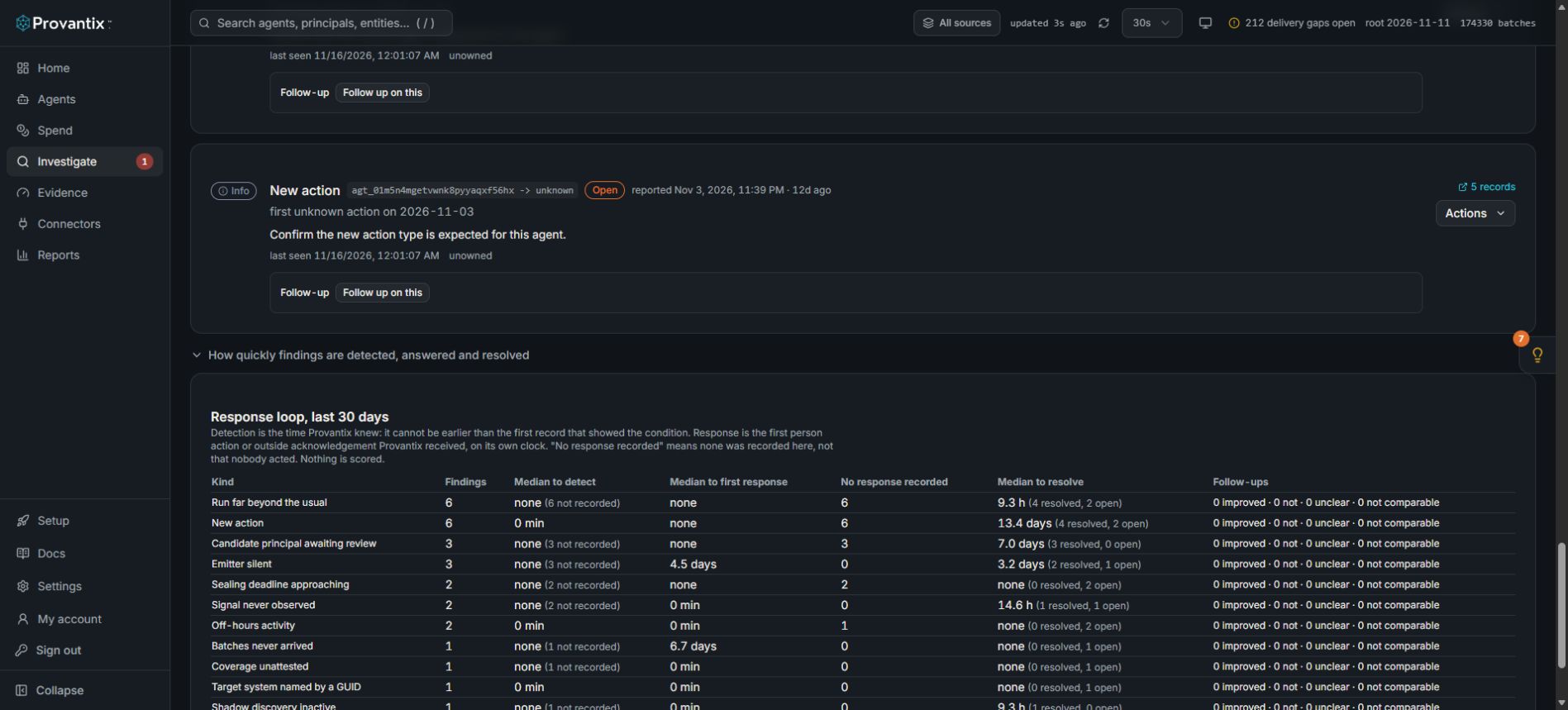
Product capture, 15–16 November 2026. Open the image for full size. Counts and dates are examples from the captured workspace.
On Findings, expand How quickly findings are detected, answered and resolved. Read detection, first response, unresolved counts and follow-ups separately. Not recorded means there is no timing evidence here; it does not prove nobody responded.
Follow-ups say what they compared
A follow-up reads what happened to a finding's condition after a decision. It compares the same finding, which is the same kind of finding on the same agent or subject, and so for most findings the thing compared cannot change.
A quality finding is different. It is produced by comparing windows under one evaluation definition: the model, dataset version, rubric, evaluator version and configuration. If one of those changes, the finding stops being produced because the comparison changed, not because quality recovered. The follow-up records the definition when it is set and again when it is read. If they differ, or the evaluator has reported nothing current, the follow-up reads not comparable, says what changed, and does not report improved.
A follow-up set before this was added has no recorded definition. It is read as before.
What it does not do
- It does not say a response was good, or that a response caused a resolution.
- It does not measure the time to change a configuration or to roll out a fix: Provantix does not see those.