Declared tools: calls outside what an agent is meant to use
A tool call the agent should not have made is a security question and a cost. Provantix can show the second only if it knows the first, so the owner declares which tools an agent is meant to use. Provantix then reports the calls outside that list and what they cost.
It never says a call was unauthorised or unnecessary. It cannot know intent. It says "not on the declared list", which is a fact about the list.
In the product
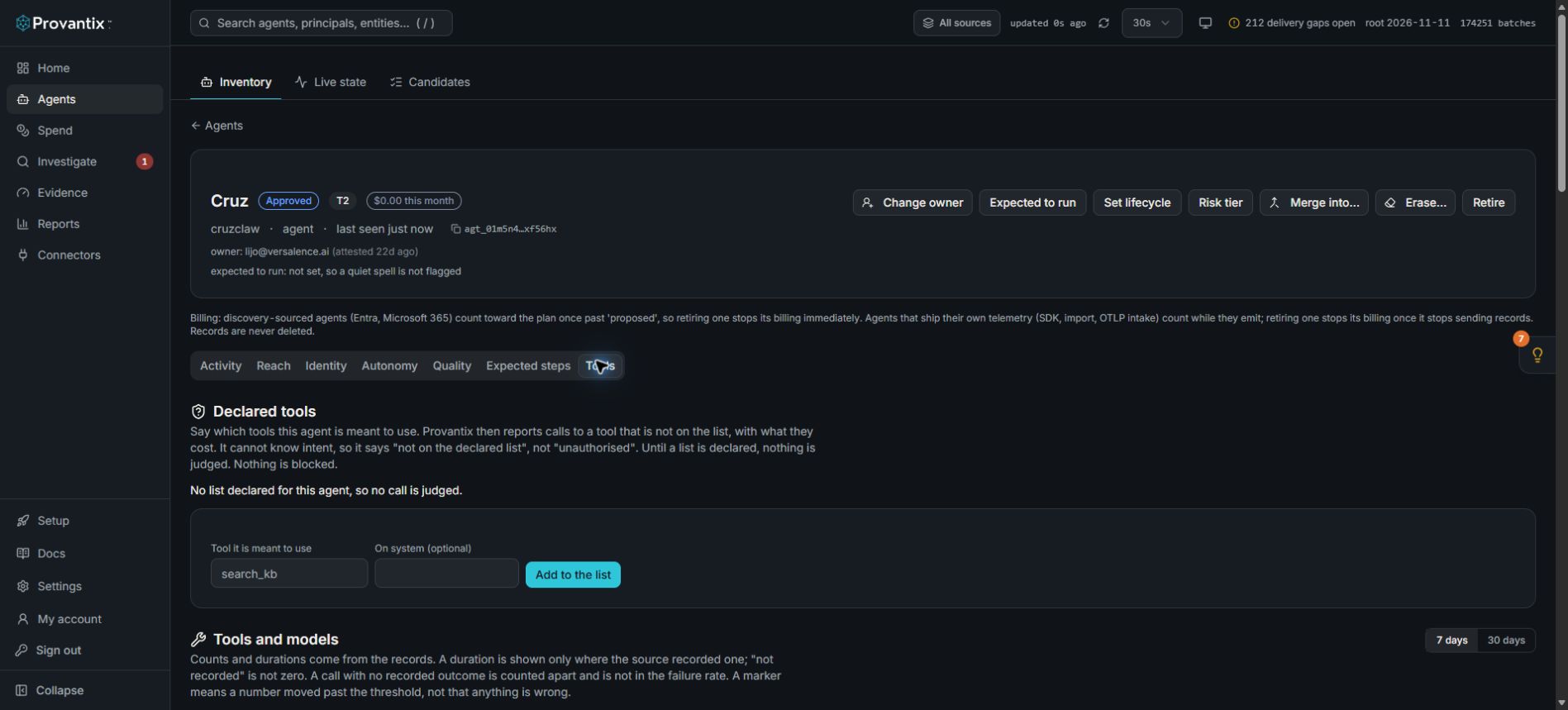
Product capture, 15–16 November 2026. Open the image for full size. Counts and dates are examples from the captured workspace.
Open an agent and select Tools. In this example no list is declared, so no call is judged against one. Declaring a list enables reporting of calls outside it; it does not block them or establish that they were unauthorised.
Declare a list
On the agent's Tools tab, under "Declared tools", add each tool the agent is meant to use, and optionally the system it is meant to use it on. A tool declared on a system matches only calls on that system.
- Each entry is kept with who declared it and when, and shows in the audit log.
- An entry is ended, never edited or deleted. The list in force on any past day can be read back.
- Nothing is blocked. Provantix is an evidence layer; it does not stop a call.
- Only an admin can declare or end an entry. Everyone in the organization can read the list.
An agent with no list is "not declared", and nothing is judged. The same holds for calls made before the declaration, and after the last entry was ended. Declaring a list does not reach back: calls are checked against the list that was in force when they were made.
What is reported
| Item | How it is added up | What it assumes |
|---|---|---|
| Calls to a tool not on the declared list | Calls by an agent that has a list, to a tool (or system) not on it: count, the cost recorded on the call, and the model call that issued each. | Nothing about intent. The list may be out of date, or the tool new. |
| Calls a control denied that were recorded as executed | The calls behind the finding "Denied by a control, but a record of the action exists", with the cost recorded on them. | The join may be probable rather than exact, and the finding says which. |
| Tool calls made after the last model call | In a run that is over (nothing recorded for 30 minutes) that has a model call: the tool calls that started after the last model call. | No later model call could have used their result. A tool whose job is an effect (sending, writing) is not wasted by this. |
| Calls whose result no later model call used | Cannot tell. | See below. |
| The same tool with the same content in one run | The calls beyond the first with the same tool and content hash in a run, with the model call that issued each. Shared with the cost of failure and repetition, shown here by tool. | The repeats beyond the first were not needed. |
| Tools that mostly fail | A tool with at least 10 calls with a recorded outcome, half or more of which failed: the failed calls, with their cost. | Nothing about why. A broken dependency, a bad argument and an expected failure look the same. |
For each: the count, the cost, the change against the period before, the split by tool and by agent (with the share of the agent's tool calls), and the runs behind it.
Why "calls with an unused result" is "cannot tell"
Telling that a tool result went unused needs a trace that says which tool results a later model call took as input. A model call's prompt reaches Provantix as one hash of everything sent, and no source Provantix reads links a result to a call that used it. A result that went unused and one that was used look the same. Provantix says so and never estimates it. If a source starts to say which results a call took, this item can be computed from it.
What a tool's cost means
A tool's cost has two parts, kept apart:
- The cost recorded on the tool call itself. Many tools report none. Then the page says "the tool's own cost is not recorded" rather than showing zero.
- The model call that issued it. The model call directly before it in the same run is taken as the turn that issued it, priced from your own price table. This is an assumption, and each model call is counted once per line.
All figures are estimates. A model call with no price is counted and marked, not treated as free.
Where it shows
- The agent's Tools tab: a column saying on the list, not on the declared list, or no list declared, a cost column, and a summary of the six items for the last 30 days.
- The finding Tool not on the declared list: medium, and high when some of the calls change or send data (delete, send, grant, revoke, download). It gives the counts, the tools, the cost recorded on the calls, who declared the list and when. It resolves when the calls leave the last 7 days or the list is changed to include the tool.
- The Cost page, Waste and savings tab, under the summary of failed and repeated calls: the same six items across the organization.
- The finding "Denied by a control, but a record of the action exists" now says what the executed calls cost.
Runbook: a finding says a tool is not on the list
- Check tracing first. If an agent's tools are not traced, every tool looks unused and none of this can be seen. Confirm the tool calls reach Provantix at all.
- Open an example call. Is the tool one the agent should be using?
- If yes, the list is out of date: add the tool. The finding resolves as the old calls age out.
- If no, find why the agent called it: a prompt that names it, a tool it was given, a changed model. Provantix cannot tell you which.
- If the call changed or sent data, treat it with the care that severity asks for, and open the run to see what came before it.
API
GET /api/agents/<id>/tool-listreturns the entries with history and whether a list is declared.POST /api/agents/<id>/tool-listwithtool_nameand optionallytarget_system,noteadds one (admin).POST /api/tool-list/<id>/endends one (admin).GET /api/tool-calls?from=&to=&agent=returns the six items. A period is at most 92 days.
Limits
- Estimates follow your price table.
- Provantix reads every call of the period. A very large period is reported as partial.
- It sees only what the sources send: an untraced tool is invisible.