Coverage unattested
What you're seeing
A Medium finding on the Findings page:
Coverage unattested — N agent(s) shipping records but no agent–system pairs are attested or granted, so Coverage cannot distinguish expected from unexpected activity.
And on the Coverage page, the headline says not computable: no attested population yet, with a table titled Observed, not attested.
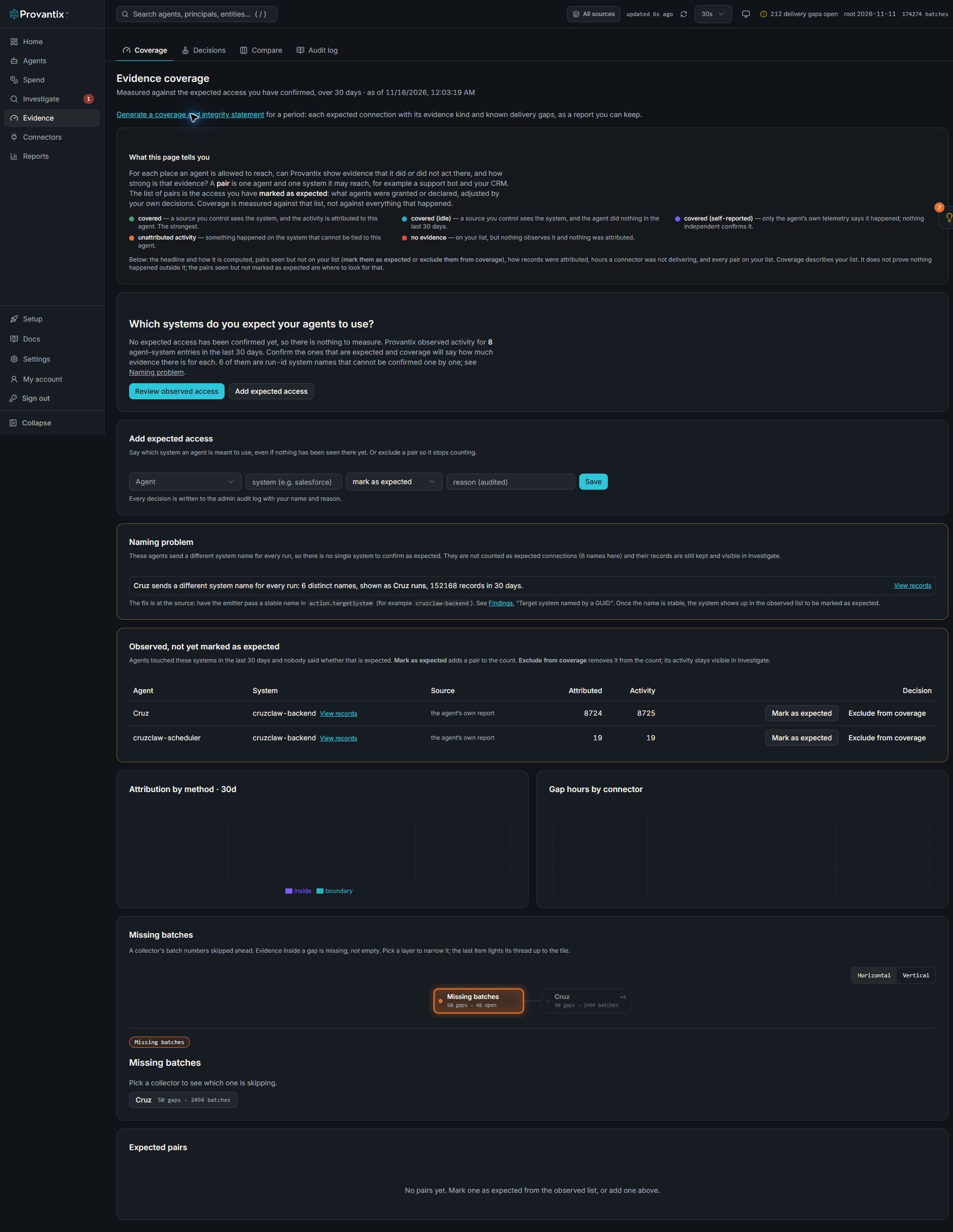
Product capture, 15–16 November 2026. Open the image for full size.
No expected access has been confirmed in this capture. Review the observed pairs and naming problems before marking access as expected; coverage is measured against that confirmed list.
What it means
Coverage answers "was everything this agent did expected?" — but only after someone declares what expected means. Until then the platform honestly reports not computable instead of guessing. The finding is Medium, not High, because nothing is broken: telemetry is flowing, records attribute to agents; the missing piece is a human decision only your organization can make.
Before you attest
Look at the system column first. If it is full of identifiers that change every run, fix that before attesting, or you will be attesting throwaway ids. See GUID-shaped target systems and the order of work in Your first Brief says attention.
What to do
- Open the Coverage page and read the Observed, not attested table. Each row is one agent and one system it has touched, with how many attributed actions the pair has.
- For each row, decide:
- Expected — the agent is supposed to touch this system. Click Attest. The pair becomes part of the attested population, and coverage starts measuring against it.
- Not expected — the agent should never touch this system. Click Exclude only after you understand why it did; an unexpected touch is often worth an investigation before you exclude it from the metric. Repeated unexpected touches on a sensitive system are a security question, not a metrics question.
- Work top-down by action count: the pair with 2,000 actions matters more than the pair with 3.
- When the table is empty, the finding resolves on the next reconciliation pass (or click Run reconciliation on the Findings page). The Coverage headline flips from not computable to a percentage you can quote.
What good looks like
The Coverage page shows a percentage against a named population (measured against the attested population), the finding is resolved, and your attestation decisions appear in the decision log — including who attested and when, which is exactly what an auditor asks for.
The honest caveat
Attesting a pair is a declaration of intent, not proof of safety. A pair can be 100% attested and still produce findings — "Cruz touched cruzclaw-backend 461 times, all inside attested reach" and "Cruz touched it in a way worth flagging" are both possible. Coverage measures completeness of expectation, not correctness of behaviour.