Reconciliation: Provantix's records against the provider
This is the page that turns cost observability into financial evidence. Provantix already compares what an agent claimed with what the system it acted on recorded. This does the same for money: what Provantix's records add up to, against what the provider says was used and charged. The difference is the finding.
It also answers an enterprise's first worry, AI usage nobody is tracking. If a provider reports more usage than Provantix has records for, something ran that Provantix cannot see.
It needs a provider connection and telemetry that names the provider. It is built from the providers' published documentation and has not been checked against a live account.
In the product
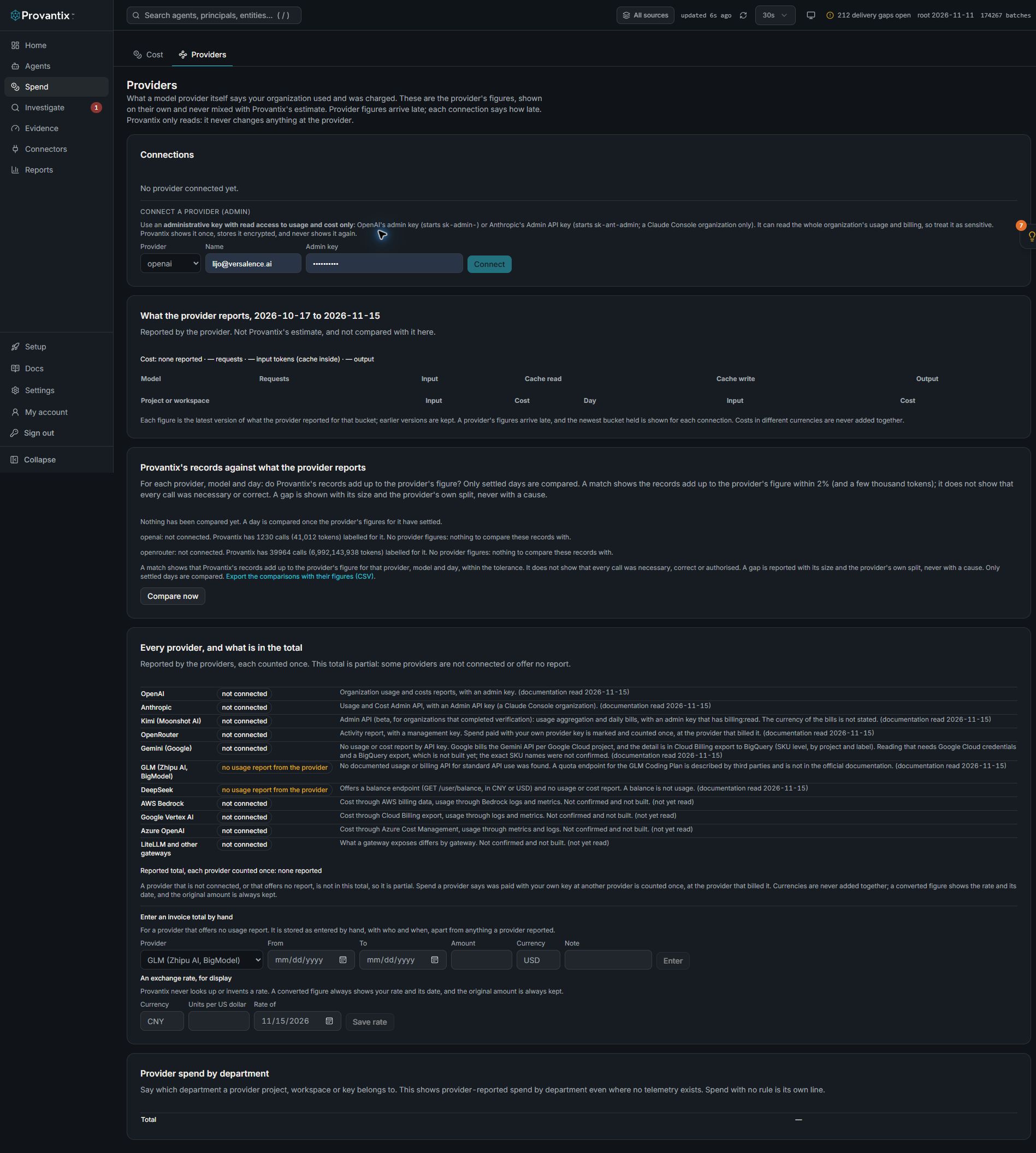
Product capture, 15–16 November 2026. Open the image for full size. Counts and dates are examples from the captured workspace.
The comparison section is on Providers, below the provider-reported tables. This example says nothing has been compared yet. Reconciliation requires provider figures for settled days; an empty comparison is not a match.
What is compared
For each provider, model and UTC day:
- Tokens. Provantix's records, input plus output (cache counted inside input, as everywhere in Provantix), against the provider's usage figures. The cache and request counts are kept beside them in each stored comparison.
- Cost. For each provider and day, Provantix's estimate from your own price table against the provider's cost.
Provantix's records do not carry a provider's project, workspace or key, so a gap cannot be attributed to one. The provider's own split for that model and day (the largest projects and keys) is shown beside a gap, so you know where to look.
Models are matched by name after a vendor prefix (openai/gpt-4.1) and a trailing date (-2025-04-14, -20250514) are taken off, so a dated name and the plain name are one model. A record counts for a provider only if it is labelled for that provider: calls through OpenRouter must carry the OpenRouter label, or they are counted against the provider they were routed to.
The states
| State | Meaning |
|---|---|
| Matched | Within the tolerance: 2% of the larger figure on tokens, 5% on cost, and tokens within 1,000 of each other always match, so a few test calls are not a gap. All three can be changed. |
| Untracked usage | The provider reports more tokens than Provantix recorded. Some usage has no records. |
| Over-recorded | Provantix recorded more than the provider reports: duplicates, a wrong provider label, or test traffic are possible, and Provantix does not say which. |
| Price difference | The tokens match and the cost does not. Provantix shows the ratio the price table would have to change by to match, and the blended price per 1,000 tokens each side implies. It does not change the price table. |
| Not comparable | It says which reason: still settling; the provider's row names no model; a currency with no exchange rate entered; some of Provantix's calls have no price; tokens do not match so cost is not compared; the provider's days are not UTC days; Priority Tier usage (Anthropic's cost report leaves it out); or the provider's cost report covers more than completions (OpenAI's covers embeddings, images and audio too, so a cost above the estimate is not compared). |
| Not connected | No provider figures for that provider. Provantix lists it with its own call count and does not call anything matched. |
Settled days only
A provider's figures lag and can be restated, so a day is compared only once its end plus the provider's settle time has passed and Provantix's own pull has covered it. The page lists the days still settling and says why. Default settle times: Anthropic 6 hours (it says figures usually appear within 5 minutes), OpenAI 24 hours and Kimi and OpenRouter 36 hours (none of these states a delay, or the delay is the next day), all changeable per provider.
Time zones and day edges
Most false gaps come from here. Provantix places a record in the UTC day it was observed, not the day it arrived, and the providers' hourly buckets are exact instants, so a day is the same on both sides. A provider whose own days are not UTC days is not compared by cost: Kimi's bills are China-time days.
Findings
- Untracked AI usage names the provider and model, on how many of how many settled days compared, the size in tokens and in money (at the provider's own price for those days), since when, and the provider's own split. It does not say why.
- Cost estimate does not match the provider says, on days when the tokens matched, how many of how many days differ and by what ratio.
They are computed from the latest comparisons over the last seven settled days, so they open, recur and resolve like every other finding: they go when the gap does.
The view
Providers shows, per provider and month, how much of what the provider reports Provantix's records explain, how much is untracked, how much Provantix recorded that the provider does not show, and what share of Provantix's own usage has no price. The money for the untracked part is an estimate from the provider's own blended price. The comparisons export as CSV with the figures compared on each line.
When the provider restates a day
The comparison is done again and stored as the next result; the earlier result is kept and the view says how many results a comparison has.
What a match does and does not prove
A match shows that Provantix's records add up to the provider's figure for that provider, model and day, within a stated tolerance. It does not show that every call was necessary, correct or authorised, or that nothing was recorded twice and missed elsewhere in equal measure. A gap does not say why it exists.