Control decisions: what an enforcement tool decided
Some tools decide whether an agent's action may go ahead, before it runs: an agent gateway, a runtime security product, a policy engine, or a customer's own approval step. They answer allow, ask a person, deny, or steer the agent to something else.
Provantix does not make that decision and is not in the path. What it can do is keep the verdict as evidence, with the policy and the version that produced it, and then do the one thing only an independent record can do: compare the verdict with what was recorded afterwards.
In the product
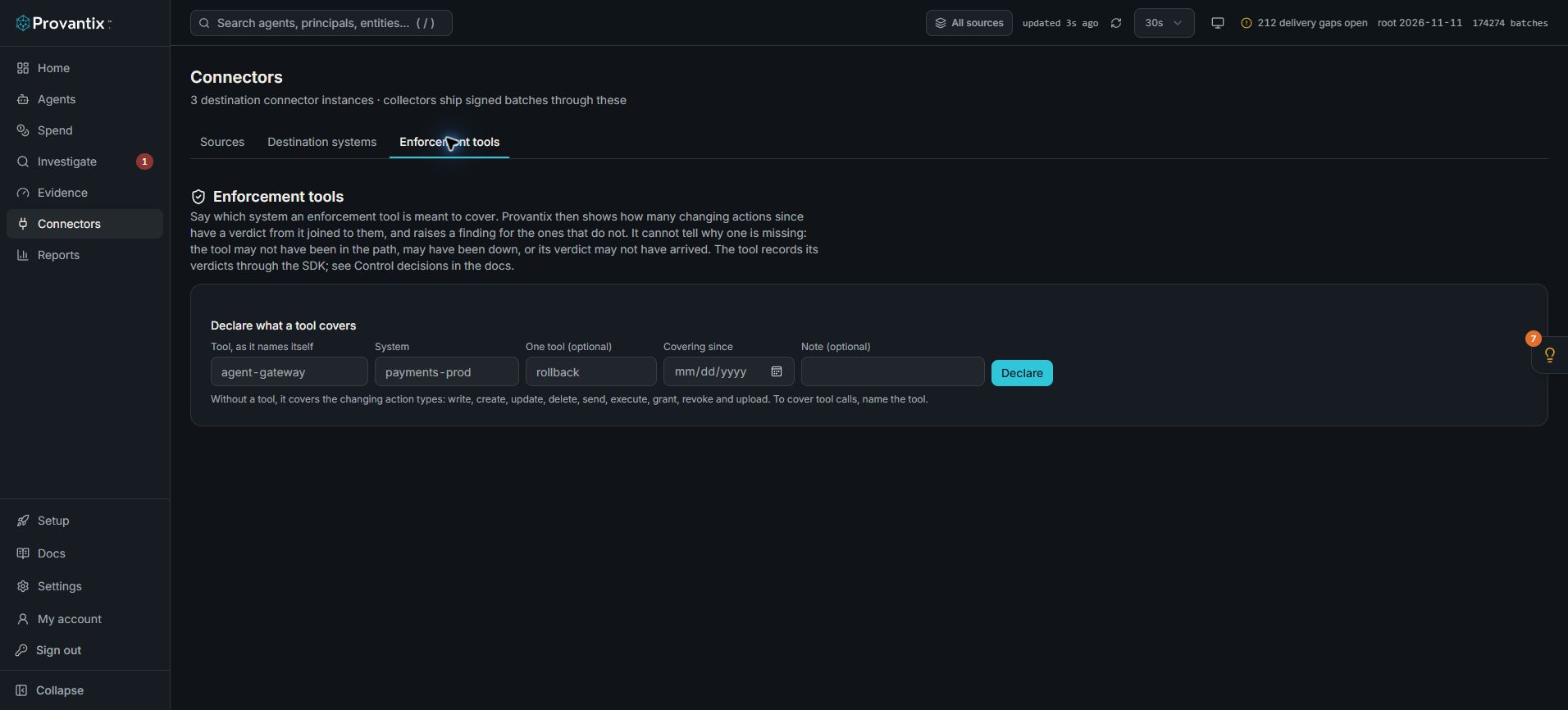
Product capture, 15–16 November 2026. Open the image for full size. Counts and dates are examples from the captured workspace.
Open Connectors, then Enforcement tools. The declaration says where verdict evidence is expected. A missing verdict can mean several things, including missing delivery; it is not proof that the control allowed an action. Provantix reports this coverage rather than enforcing the action.
What gets recorded
The enforcement tool (or glue code next to it) records one control decision per verdict, using the SDK (see "Control decision evidence" in the SDK README). It holds:
- the enforcement tool's name and version;
- the verdict:
allow,ask,denyorsteer; - the policy that decided, and its version;
- a short reason, a risk reference, an approval reference and the time, when it has them;
- what was proposed (system, tool, target, a short summary), and an action id when it can give one.
It is kept as a record of its own, sealed like any other. Provantix does not store raw prompts or a tool's full arguments, and the SDK refuses anything that looks like a credential.
A verdict is the enforcement tool's own statement. It is not Provantix's judgement, and it is not proof the control worked.
How it is compared with what happened
Each decision is compared with the records that followed:
| Joined by | How sure | When |
|---|---|---|
| the same action id on the decision and on the action's own record | exact | The action's record carries the id (control_ref, the decision pointer, or its claim). |
| the same trace, the same system and tool, within minutes after | probable | No action id ties them. It is marked probable wherever it appears. |
For a deny, the result is one of:
- Denied, but executed: a record carrying the same action id exists.
- Denied, but possibly executed: a probable join only.
- Denied, no record seen: nothing was recorded. This is not the same as the action not having happened, unless a destination check covers it.
For allow, ask and steer the comparison is shown too, and none of them is a finding.
The finding
A deny with a record of the action raises Denied by a control, but it happened (control_denied_but_executed): high when the join is exact, medium when it is probable. It names the enforcement tool, the policy and the reason, says how the join was made, and says when the destination's own record also confirms the action.
It never says the control failed. Provantix does not know where the tool sits in the path, so the finding says only what is known: it did not stop this action, did not cover this route, or the action ran another way. Finding out which is the next step, and the finding's recommendation says so.
Actions that ran with no verdict
A deny that was ignored is one way a control is bypassed. The other is an action the control never saw. Provantix cannot know where an enforcement tool is deployed, so you tell it.
On the Connectors page, on the Enforcement tools tab, declare that a tool covers changing actions on a system, optionally one tool on it, from a date. This is your statement: Provantix does not check the deployment. It keeps the statement with who made it and when, and never edits it: ending a declaration keeps it on record.
Provantix then checks the changing actions recorded on that system since the date, and shows how many have a verdict from that tool joined to them, for example 31 of 34 changing actions have a verdict (29 by action id, 2 probable); 3 do not. For the ones that do not, it raises Action with no control decision (action_without_control_decision), medium, with examples.
- What counts as a changing action: write, create, update, delete, send, execute, grant, revoke and upload. Most tool calls only read, so a tool call is covered only when you name the tool.
- Whose verdicts count: only verdicts from the tool you named, by the name it uses for itself. Another tool's verdict does not cover the action.
- A grace period: the last two hours are left out, so a verdict still arriving is not called missing.
- It does not say why. The tool may not have been in the path for those actions, may have been down, or its verdict may not have reached Provantix. The finding names all three and picks none.
Where you see it
- The run page: a card, "What an enforcement tool decided", and badges on the action (denied by a control, but recorded, with probable when it is).
- Incidents: a control decision stage in the timeline, and the contradiction stated in words.
- The autonomy assessment: verdicts are counted apart from the agent's own actions, and a denied action that still has a record is a reason for the owner to review.
- Findings feed: the finding is an ordinary finding, so a consumer receives it like any other.
In exports and the offline verifiers
Verdicts travel in exports as ordinary records. When an export holds a verdict, or an action that points at one, both the Node and the Python verifier add two checks:
- Every control decision agrees with the action that cites it. It fails when an action's pointer names a different action than the verdict does, or when two records claim the same verdict id. Those are the edits someone would make to a copy of the record set, and they are caught even when every hash is recomputed.
- Control decisions are well formed. It fails on a verdict that is not allow, ask, deny or steer, or one that has no enforcer name or policy.
A verdict that is not in the export, or that names no action, is reported and does not fail the export. A denial that an action record points at is reported too ("denied by the enforcer and cited by an action record in this export"), as the enforcer's statement beside a record. It is not a finding about the control, and a missing record of an action is not proof it did not happen. The rules are in the specification (FORMAT.md, "Control decision evidence") and covered by six conformance vectors.
What this does not do
- It does not block anything. The enforcement tool does that.
- It does not know which actions an enforcement tool covers unless you say. Without a declaration, an action that ran with no verdict is not reported.
- It does not read a vendor's own logs. The verdict has to be handed to Provantix through the SDK. No vendor integration is assumed, and none is built yet.
- The offline verifiers check that the records agree with each other, not that the control worked. See the next section.