Providers: what OpenAI and Anthropic report
Everything else Provantix shows about cost is its own estimate from the telemetry agents send. It never asked the provider what was actually used or charged, so it could not show usage no agent reported, and its figures could not be checked against the bill. A provider connection asks the provider.
This is the provider as something Provantix watches. It has nothing to do with the model the AI Insider uses to word its answers.
Status: built from each provider's published documentation (read 2026-11-15) and tested with responses shaped from it. It has not been run against a live OpenAI, Anthropic, Kimi or OpenRouter account, so check the first pull on the Providers page. The state of each is also in What each source can carry.
Four providers can be connected: OpenAI, Anthropic, Kimi (Moonshot AI) and OpenRouter. The rest of the list, and what to do for a provider that offers an organization nothing, is under Every provider, and the total, below.
In the product
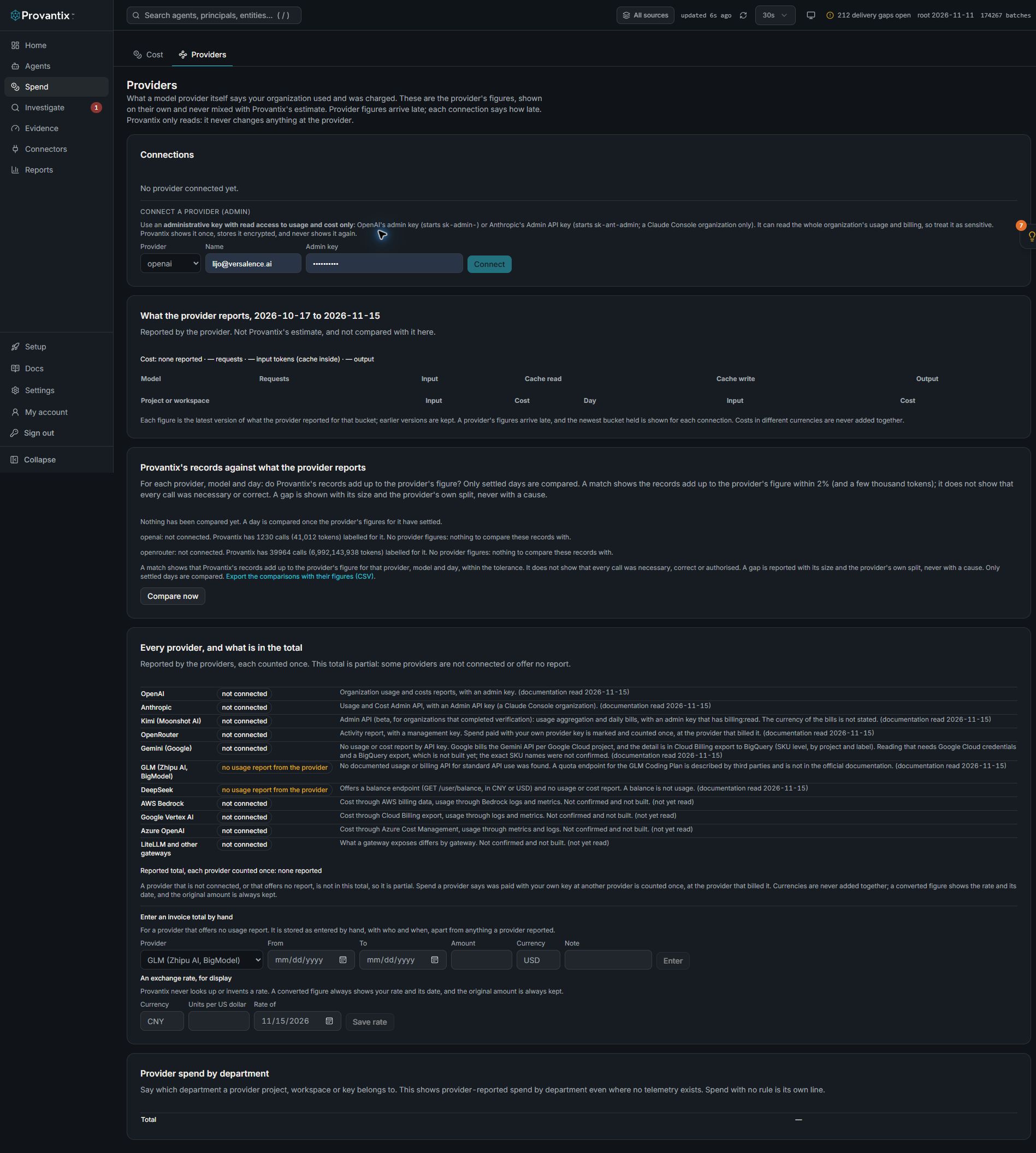
Product capture, 15–16 November 2026. Open the image for full size. Counts and dates are examples from the captured workspace.
Open Spend, then Providers. No provider is connected in this example, so no provider figure can be compared with the telemetry. The availability table distinguishes not connected from no report available; neither is a zero-spend result.
What you need
A key that can read the whole organization's usage and cost. Create it at the provider, with read access to usage and cost only, and treat it as sensitive: it can read every project's usage and the billing behind it.
| Provider | Key | Notes |
|---|---|---|
| OpenAI | An admin key (starts sk-admin-), from Organization settings, Admin keys. A project key or service-account key cannot read organization usage. |
Reads the completions usage report and the costs report. |
| Anthropic | An Admin API key (starts sk-ant-admin), from the Claude Console, Organization settings. An ordinary or workspace key does not work. |
Only a Claude Console organization has one: not a claude.ai Team plan, and not an individual Console account. |
| Kimi (Moonshot AI) | An Admin key (starts sk-admin-) with the billing:read scope, created by an organization admin under Organization, Admin API Keys. An ordinary inference key cannot read usage. |
The Admin API is a beta, for organizations that completed organization verification. |
| OpenRouter | A management key (starts sk-or-), from OpenRouter's management keys. An ordinary key is refused with 403. |
Reads the activity report. |
Provantix cannot check that a key is limited to reading. It only ever reads (its client has a GET method and no other), but the key itself may be able to do more, which is why you create it with read access only and keep control of it.
Connect, replace, revoke
Providers, Connect a provider (admin). The key is shown once, here, stored encrypted, and never shown again: not on the page, in the API, in a log, or to the AI Insider. Provantix tests it at once, so a wrong key is seen immediately.
- Replace key swaps in a new key (the old one is wiped) and tests it. What was already collected is kept.
- Revoke wipes the stored key and stops all pulling. What was collected stays. Also delete the key at the provider.
- Connecting, replacing and revoking are each recorded with who did it.
What is pulled, and how often
Hourly, and on demand with Pull now. The first pull goes back 30 days. Each pull starts a little before where the last one ended, so a restated figure is caught.
| Usage | Cost | |
|---|---|---|
| OpenAI | by hour, grouped by project, key, model and service tier: requests, input tokens (cache included), cached and cache-write tokens, output tokens | by day, grouped by project and line item, in the currency OpenAI states |
| Anthropic | by hour, grouped by model, workspace, key and service tier: uncached, cache-read and cache-creation input tokens (added up to the total input), output tokens | by day, grouped by workspace and description, in US dollars (the report gives cents) |
| Kimi | by hour, grouped by model, project and key: requests, prompt tokens (cached tokens are inside them), completion tokens, cache-write tokens where given | by day from the daily bills, by model and token type, plus the part of each day's total the model rows do not explain (cache storage, tool calls, batch) |
| OpenRouter | by day per model endpoint: requests, prompt, completion, reasoning and cached tokens | by day per model endpoint: what was paid in OpenRouter credits, and, as its own marked row, what was paid with your own provider key |
Kimi's currency is not stated. Kimi's documentation gives its bills in milli-cent and says 1 USD = 100,000 milli-cent, but does not say which currency a bill is in. Provantix stores the amount divided by 100,000 and records no currency, and shows it as "currency not stated by the provider", instead of calling it dollars or yuan. Kimi's days are China-time days and its figures are ready the next day from 07:00 China time; Provantix asks only for what is ready.
OpenRouter and your own key. OpenRouter reports separately what you paid in its credits and what you paid with your own key at the underlying provider (OpenAI, say). That second amount is also in that provider's own report. Provantix keeps it as its own row, marked as paid with your own key, and counts it once, at the provider that billed it, in the total and in the department split.
What each report leaves out. OpenAI: only the completions usage report is read; embeddings, images, audio, moderations, vector stores and code interpreter sessions have their own reports, not read yet. Anthropic: the cost report leaves out Priority Tier, which appears in the usage report under service tier priority; and Anthropic's newer Usage and Cost Analytics API (a beta, which can group by the person behind a request) is not read yet. Whether Codex usage appears in OpenAI's report is not confirmed by the documentation.
How late. Provider figures arrive late, and the page says how late for each connection: the newest hour held and how many hours ago it ended. Anthropic says its figures typically appear within five minutes, with occasional longer delays. OpenAI does not state a delay.
What you see
The Providers page (Spend, then the Providers tab) shows what the provider reports on its own: usage by model, by project or workspace and by day, and cost by project and by day. Every figure is labelled as reported by the provider. It is not Provantix's estimate and is not compared with it there. Amounts in different currencies are never added together.
Restatements. A provider can restate a past bucket. The new figure is stored as a new version beside the earlier one, each with the time it was fetched. Nothing is overwritten. The page shows the latest and says how many rows were restated.
Provider spend by department
Say which department a provider project, workspace, or key belongs to (an empty project is the default workspace), from a date. Provider-reported spend then shows by department even where no telemetry exists. A project with no rule is its own line, no rule covers this spend, and is never spread over the others. Rules are effective-dated and ended, never edited.
When it goes wrong
- A key the provider rejects (revoked, expired, not an administrative key) marks the connection credential no longer valid and raises the finding
data_health.provider_credential. It resolves when you replace the key. - A connection that has not pulled successfully for six hours raises
data_health.provider_stale: figures from that provider stop at the last good pull. - A provider that is down or rate-limiting leaves the connection degraded and is tried again. It is not a finding until it has lasted six hours.
- A connection you revoked is a choice, not a finding.
Every provider, and the total
Providers lists every provider Provantix knows about, so the total is never silently partial.
| Provider | State | What the documentation offers (read 2026-11-15 unless noted) |
|---|---|---|
| OpenAI, Anthropic, Kimi, OpenRouter | connectable | Usage and cost with an administrative key, as above. |
| Gemini (Google) | not connected | No usage or cost report by API key. Google bills the Gemini API per Google Cloud project, and the detail is in Cloud Billing export to BigQuery, at SKU level by project and label. Reading it needs Google Cloud credentials and a BigQuery export, which is not built yet. The exact SKU names were not confirmed. |
| GLM (Zhipu AI) | no usage report from the provider | No documented usage or billing API for standard API use was found. A quota endpoint for the GLM Coding Plan is described by third parties and is not in the official documentation. |
| DeepSeek | no usage report from the provider | A balance endpoint (GET /user/balance, in CNY or USD) and nothing on usage or cost. A balance is not usage. |
| AWS Bedrock, Google Vertex AI, Azure OpenAI | not connected | Cost through the cloud's billing data and usage through its logs or metrics. Not confirmed and not built. |
| LiteLLM and other gateways | not connected | What a gateway exposes differs by gateway. Not confirmed and not built. |
The total. It adds what the connected providers report, each counted once, per currency. Amounts in different currencies are never added together. A provider that is not connected, or that offers no report, is named under the total, and the total says it is partial.
A provider that offers nothing. Provantix does not guess and does not read a console. Its spend appears only as Provantix's own estimate from telemetry, labelled as an estimate, and the provider is listed as "no usage report available from the provider", with the date its documentation was read. An admin can enter an invoice total for a period by hand. It is stored as entered by hand, with who and when, apart from everything a provider reported; a correction is a new entry that names the one it replaces; and it is never added to the reported total. A later comparison can use it as a total only and says so.
Currencies. Amounts are stored in the provider's currency, as it gave them. To show a figure in dollars, an admin enters a rate (units per US dollar) and its date. Provantix never looks up or invents a rate. A converted figure always shows the rate, its date and who entered it, and the original amount is always kept.